The SpaceX IPO – Dystopian Morality Tale, or Inspiring Venture?

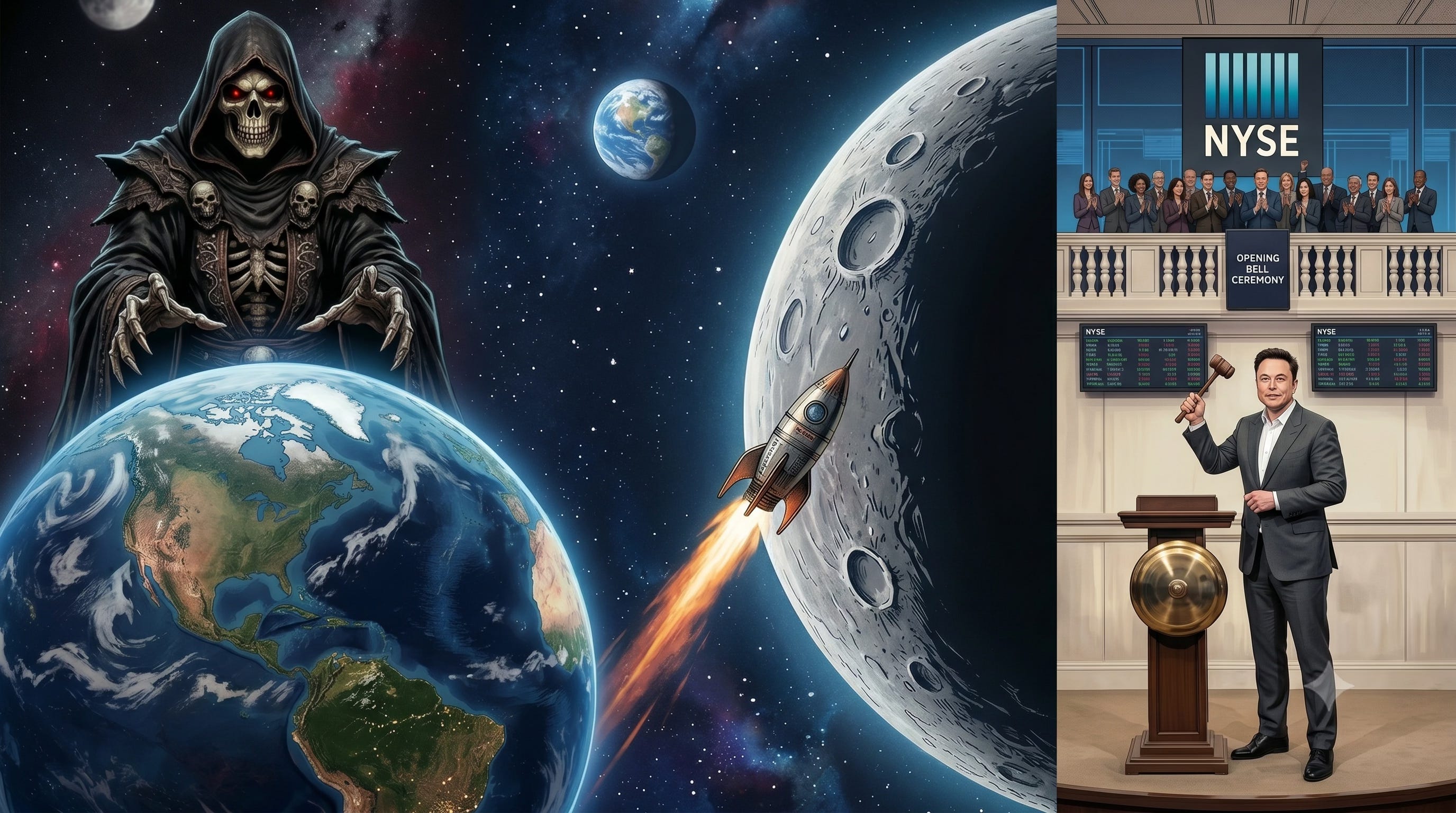
On a recent episode of The Daily podcast, The New York Times (NYT) managed to subtlety twist the IPO (Initial Public Offering) for SpaceX into something of a morality play. As if the whole thing were a dystopian attempt by some kind of Billionaire Darth Vader to take over the universe, with everything from the world’s financial system to your grandmother’s IRA hanging in the balance.
So, is the largest IPO in history really just Billionaire Vader trying to convince us to fund his Evil Empire? Or is this a story of American-style capitalism attracting the best and brightest from around the world to unleash the infinite possibilities of human ingenuity?
And, while we’re at it, should grandma really be losing sleep over all this?
With all these intergalactic possibilities rattling around the ole noggin, let’s dig a little deeper.
The Take at The Times
While they didn’t exactly put it in so many words, the NYT’s take more or less boiled down to: SpaceX has identified a total addressable market for it’s products of $26 trillion, which is nearly the size of the entire U.S. economy. And, to justify the gargantuan valuation Musk is seeking for his business, he’s basically going to have to monopolize the whole shebang, (which, according to this worldview, is pretty much the definition of a billionaire anyway, right?) So, in order for this thing to work, Darth Musk has to take over the universe.
I mean, like, yikes!
And, just in case you still haven’t crawled under the mattress you’re now thinking of stashing your hard earned savings into, Lord Musk has super voting control, which means neither his Board of Directors nor the shareholders can get rid of him; sort of a Darth Vader for life agreement, if you will.
But wait, just when you thought it couldn’t get any scarier: to help get all the moola he needs, Mr. Vader convinced the index mutual funds (which buy large diversified baskets of stocks on behalf of their investors) to bend a few rules so they can get in on the launch pad for his venture. So, even if you’re not really into funding madcap schemes, you don’t really have a choice, it’s likely to end up in your IRA or your 401-K or your ICH (I’m Confused as Hell about all these acronyms) anyway!
So, you’re basically damned if he does (monopolize the universe) and damned if he doesn’t (because your financial house of acronyms will go down with the starship if he fails). I mean, what’s a humble earthling to do, right?
Of course, what they didn’t say is that even the biggest company in America last year (Amazon) had sales equal to only about 2% of the U.S. economy - so maybe there’s not quite as much to the whole monopoly thing as they’d like to make it seem. (But hey, what ideology-promoting journalistic enterprise ever let facts get in the way of a good story?)
And they also didn’t say that, if grandma has, say, 5% of her assets in an index fund which has, maybe 1 or 2% of its investments in SpaceX then …well, let’s just say she can still plan on waking up to that warm bowl of oatmeal no matter how it all works out.
With respect to the super voting control shares, does anybody anywhere actually think anyone other than Elon Musk has a snowball’s chance in a solar panel field of pulling this whole thing off? Imagine the Board does fires him. What’s the job posting gonna say: “Wanted: New CEO with a demonstrated history of Thomas Edison’s inventiveness, Henry Ford’s manufacturing genius, and P.T. Barnum’s salesmanship – all others need not apply”?
An Alternative Perspective
Suffice to say, I’ve read my fair share prospectuses. And even though SpaceX isn’t my kind of investment (more on this in a moment), this one reads like an investment banker’s version of Fifty Shades of Grey. Along with a bunch of color pictures of rocket ships in space that are more or less centerfold-like material for the nerds that read these things, it starts out by noting, “Our mission is to build the systems and technologies necessary to make life multiplanetary, to understand the true nature of the universe, and to extend the light of consciousness to the stars.”
I mean, it almost makes you feel guilty for just hoping you can make a buck or two off the damn thing, right?
At another point, the prospectus goes on: “We believe AI infrastructure in space can utilize the virtually limitless power of the Sun and thereby enable the use of AI as a transformative force for understanding the universe and improving the daily lives of all humans.”
Wow, just imagine how the NYT would react if that came from a dewy-eyed socialist in a blue tie promising to tax the hell out of everyone else and then hire the guys & gals in charge of California’s bullet train to nowhere to build it!
Which brings us to a key point here. Musk’s accomplishments and vision are genuinely inspiring. And how cool is it that people investing either their own money, or money they have a fiduciary responsibility for, are voluntarily funding SpaceX’s audacious aspirations? Where else could a kid from another country born outside of political privilege go to try and make science fiction dreams come true?
In other words, if you don’t think American-style capitalism is exceptional, you might want to take a moment to scan through the SpaceX prospectus.
A Venture Capital Style Investment
Earlier I noted that, in spite of all the inspirational possibilities here, this isn’t my cup of investing tea. My preference is to focus on mature, consistently profitable companies with good growth prospects whose stocks can be acquired at attractive prices. SpaceX is more like a venture capital investment, where you’re betting on the founder, their track record, and their vision. But, no matter how good it all sounds, you accept that it’s still hard to tell how big the market will be, what share the company will command, what the financial and operating characteristics of the business will ultimately be, and so on.
In this respect, it’s helpful to keep in mind that experienced investors typically allocate only a portion of their portfolio to venture capital, and that portion usually gets spread over a number of venture funds. And each of those funds diversifies it’s portfolio to protect against the inherent nature of venture investing, which is that you know a large percentage of your investments will fail, but you’re hoping for one or two moon shots to make up for all the loses.
In other words, no matter how inspiring or exciting you find these kinds of things; think hard before you bet grandma’s oat farm on it.
Today we face important challenges, but none that are greater than those we have overcome time and again throughout our storied history. Here’s to hoping your day is as bright as America’s future.
- Todd, June 7, 2026
If you found this helpful, please recommend it to at least one other person.
Subscriptions are currently FREE – if you’re not already a subscriber, sign up below.
These posts are now available in a podcast format as well, just search my name and On Wealth and Progress on major platforms.
If you’d like to learn more, visit my website: toddsheetswriter.com
To purchase a copy of my book, 2008: What Really Happened, please go to Amazon.com, barnesandnoble.com, Bookshop.org, or encounterbooks.com.
Disclaimer: The preceding content is for informational purposes only based on information available when created. It is not an offer or solicitation nor is it tax or legal advice. It does not consider your financial circumstances and objectives and may not be suitable to you. Readers and listeners are encouraged to consult with a financial advisor who can consider your individual circumstances before making any investment decisions
“Here’s to hoping your day is as bright as America’s future.”
I like that.
Yours too.