BILLIONAIRE$


In Colorado a couple of months ago I came across a street post bearing a sticker that read: “ELIMINATE BILLIONAIRE$ - SAVE THE WORLD”.
A few weeks ago, on the It’s Open with Ilana Glazer podcast, Alexandria Ocasio-Cortez, one of the leading contenders to become the Democratic Party’s next presidential candidate, said, “You can’t earn a billion dollars; you just can’t. …You can break rules. You can do all sorts of things. You can abuse labor laws. You can pay people less than what they’re worth. But you can’t earn that, right? And so you have to create a myth… You have to create a myth of earning it.”
This week, CNBC’s Andrew Ross Sorkin opened a wide ranging and hotly debated interview with Amazon founder Jeff Bezos by asking him about the source of all this hostility. Bezos replied that it’s a function of recent economic conditions where some people have done very well while others struggle.
In fact, this explanation has become so widespread that it has a name: the “K-shaped economy”, with the upward and downward angled lines on the “K” representing these divergent outcomes. While I admire Mr. Bezos and much of what he said in the CNBC interview, I disagree with his diagnosis of why billionaires are being demonized by so much of the political class. If Bezos’s perspective was correct, then this hostility would be a recent phenomenon, but history reveals that the issues here are much deeper and more intractable.

In the mid-1800s Karl Marx and Frederick Engels published The Communist Manifesto and Das Kapital, in which they made three basic arguments: 1) the history of mankind is one of class warfare between oppressors and the oppressed, 2) capitalism, which they saw as the contemporary version of this never ending struggle, was doomed to collapse as a result of its own tendency toward excess and self destruction, and 3) post-capitalist society would emerge into communism, characterized by the abolition of private property in pursuit of a utopian vision of collective ownership and politically distributed rewards.
As stirring as all this may sound to some, history has delivered a crushing verdict on Marxist economics. Communism collectively destroyed hundreds of millions of working class lives in countries large (the Soviet Union and China) and small (Cuba) that spanned the globe from Eastern Europe to Asia to Latin America. In addition, countries that embraced less extreme, socialist, versions of collectivism have vastly underperformed capitalist countries. And finally, the United States did far more to improve working class lives when it operated under the limited government model than it has under the growing government model of the past century.
In its first iteration, American-style capitalism flourished in a manner unseen anywhere else in history. Prior to capitalism, world GDP grew at around 0.3% per year for the three-plus centuries from 1500-1820. Then, limited government capitalism unleashed U.S. growth of a little over 4% annually (over inflation) from 1820 until World War I (1913).
To put this in perspective, a hypothetical family with annual income of $100,000 growing at 0.3% for roughly 4 generations will see its earnings rise to about $135,000 after 100 years.
But if a similar family’s income grows by 4.0%, it will increase to over $5,000,000 annually!
Now, imagine which family will live in a safer and more secure neighborhood. Which one will have access to better schools and medical care? Which one will have more time to spend with friends and family, and more opportunities to enjoy the arts and entertainment, and to pursue careers in these fields? Which one will be able to do more to help the less fortunate?
So then, given the widespread failure of Marxist ideas and the extraordinary success of limited government capitalism, how do we explain the persistence of Marx’s failed theories?
The answer is simple: political greed - while Marx was a disaster on economic issues, he was brilliant in foreseeing how class warfare narratives could be used to build political movements and coalitions.
The role of politicians and their advisors in directing economic outcomes was vastly curtailed by free market capitalism. But with the rise of progressivism in the early 20th century, the political class struck back with Marxist-like charges of inequality, exploitation and oppression. Progressives have long worked to embed these narratives into our history books, culture, media and politics - to the point where even many of today’s billionaires (Buffett, Gates, Bezos and others) occasionally fall into the trap of accepting Marxist assumptions as the starting point for policy discussions about how to build a better society.
Ideally, instead of relying on politically motivated anecdotes about the so-called progressive era, we would be able to take a poll of contemporary people on their feelings about limited government capitalism. Fortunately, we can do even better: rather than merely asking what they thought, we can follow they actually did.
Migration and population patterns reveal how people as a whole really felt about early American style capitalism. Domestically, millions voluntarily flocked from the farms to rapidly emerging urban areas to work in the factories that built the great industrial cities of the Midwest and Northeast. Internationally, people braved extraordinary hardship to escape politically-controlled economies around the world in order to pursue a better life in America. All of which is why, from 1820-1920, our population soared over tenfold, from 10 to 106 million.
If on the whole, as progressives allege, the working class had been ruthlessly exploited, they would have promptly packed up their bags and moved back to the farms or their countries of origin. But they stayed and worked hard to bring other family members to join them in what the Jewish community came to call the Goldene Medina, or golden land.
This went on for generation …after generation …after generation, until progressives turned the Great Depression into a narrative of private market failure that seemed to fulfill Marx’s most dire predictions about capitalism. We now know, however, that the Depression was caused by unprecedented failures of government both abroad (the collapse of the international monetary and financial systems under the weight of blowout deficit spending on WWI) and at home (the failure of the recently created Federal Reserve to provide the liquidity needed to protect our banking system from deposit runs).
And yet today, we still hear cries us to eliminate the billionaires, and the Democratic Party has turned to leaders that proudly identify as socialists while vilifying people like Jeff Bezos, whose own working class father fled Cuba as a penniless teenager for the opportunity to work tirelessly so his children could pursue a dream that is, because of free market capitalism, uniquely American.
To paraphrase Fitzgerald (The Great Gatsby): And so we beat on, boats against the current, born back ceaselessly into the past because of misleading narratives of capitalist greed that disguise the fact that all of human history reveals political greed as the real impediment to genuine progress.
Today we face important challenges, but none that are greater than those we have overcome time and again throughout our storied history. Here’s to hoping your day is as bright as America’s future.
- Todd, May 24, 2026
If you found this helpful, please recommend it to at least one other person.
Subscriptions are currently FREE – if you’re not already a subscriber, sign up below.
These posts are now available in a podcast format as well, just search my name and On Wealth and Progress on major platforms.
If you’d like to learn more, visit my website: toddsheetswriter.com
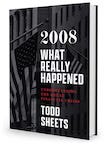
To purchase a copy of my book, 2008: What Really Happened, please go to Amazon.com, barnesandnoble.com, Bookshop.org, or encounterbooks.com.
Eliminate the ideology that people are perfectible and save the world.
Eliminate Radicalized, White, Affluent, Liberal women and save America.
Eliminate the obsession to make life fair and equal and save the world.